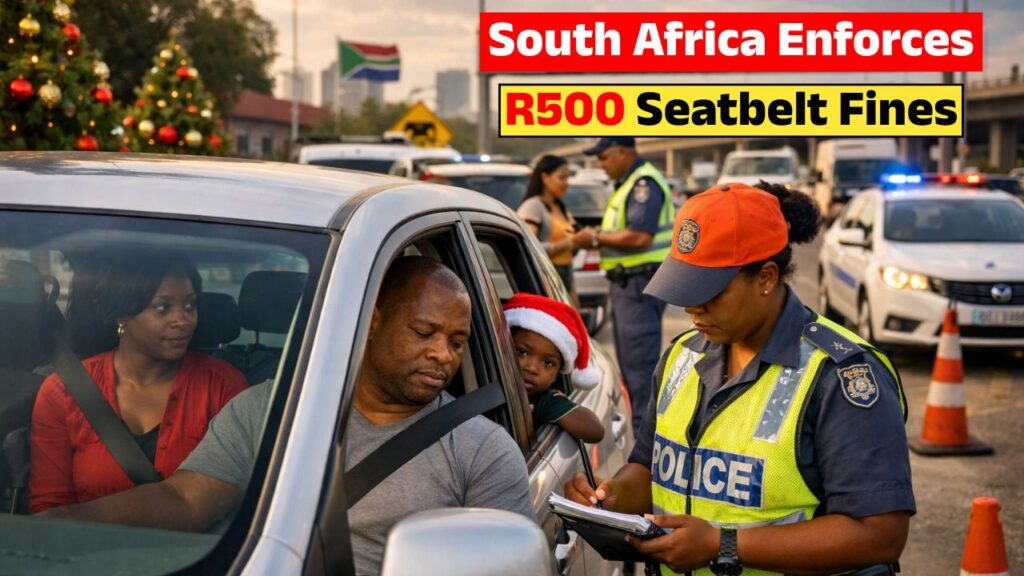
South Africa will bring in stricter road safety rules in December 2025. The new regulations will require all vehicle passengers to wear seatbelts or face a R500 fine. This change is part of a nationwide plan to reduce injuries and deaths from road accidents by making sure everyone in a vehicle uses proper safety restraints while traveling. The government hopes these tougher penalties will encourage better compliance with seatbelt laws. Road safety officials have noted that many passengers still travel without buckling up despite existing regulations. The R500 fine applies to each person found without a seatbelt during traffic stops & vehicle inspections. Transport authorities believe the updated rules will create safer roads across the country. Statistics show that wearing seatbelts significantly reduces the risk of serious injury or death in accidents.
December 2025 Seatbelt Law Update: Revised Fines and Enforcement Rules
From December 2025, wearing a seatbelt will be compulsory for every person inside a vehicle, no matter where they are seated. This updated regulation applies to private cars as well as public transport, including taxis, minibuses, and buses. Traffic authorities will increase roadside checks and enforcement operations. Any driver or passenger found without a seatbelt will face an immediate R500 fine, with no warnings issued. The rule is designed to ensure consistent compliance across all road users in South Africa.
| Regulation Aspect | Revised Details |
|---|---|
| Seatbelt Penalty | R500 charged for each individual not wearing a seatbelt; fines apply per person |
| Effective Start Date | Enforced nationwide beginning December 2025 |
| Who Must Comply | All drivers, front and rear passengers, including users of public transport |
| Applicable Vehicles | Private cars, taxis, minibuses, buses, and all passenger-carrying vehicles |
| Enforcement Approach | Implemented through roadblocks, random traffic stops, and routine inspections |
| Repeat Violations | Stricter consequences including increased fines and possible legal proceedings |
Government’s Reasoning Behind the New R500 Seatbelt Fine
The South African government introduced the stricter seatbelt enforcement to tackle the rising number of road accidents and fatalities. Research shows that seatbelts significantly lower the risk of severe injuries during collisions. By setting a clear and uniform penalty, officials aim to promote safer driving habits and encourage people to buckle up on every trip. Authorities believe that stronger enforcement will improve overall road safety, especially during peak traffic hours and long-distance travel.

Drivers, Passengers, and Vehicle Types Covered Under the Law
The revised seatbelt regulation applies to drivers and passengers in both front and rear seats, across all vehicle categories. This includes private vehicles, taxis, minibuses, and buses. Passengers using public transport are equally responsible for wearing seatbelts where available. Parents and guardians traveling with children must also ensure proper child restraint systems are used according to existing safety laws. The responsibility for compliance rests with every individual before starting a journey.
Repeat Offences: Escalating Penalties and Legal Consequences
Motorists or passengers caught violating the seatbelt rule multiple times may face harsher consequences. Repeat offenders could be issued higher fines or face additional legal action. If the initial R500 fine is not paid within the specified period, extra charges may be added. Authorities are using escalating penalties as a deterrent to ensure long-term compliance with road safety regulations.

Essential Seatbelt Compliance Facts Every Road User Must Know
– Wearing a seatbelt is compulsory for all vehicle occupants, regardless of seating position.

– Failure to comply results in an immediate fine of R500.
– The regulation comes into force from December 2025.
– The rule applies to private vehicles and all forms of public transport.
– Repeated violations may lead to higher fines or additional legal penalties.